Most broadly, my research focuses on the histories and politics of “race,” “whiteness,” immigration, and multiculturalism in Canada. I also retain an active research interest in biography as a research methodology.
My present long-term project is a critical history of the Canadian federal government’s policy of multiculturalism: its ideological origins; its implementation, evolution, and reception by the public; and its adoption by other countries.
Published in 2021, The Racial Mosaic: A Pre-History of Canadian Multiculturalism, completes the first stage of this project. The second stage, currently in progress, is entitled “The Making of Official Multiculturalism in Canada, 1971-1988.” It examines the history of multiculturalism as an official policy in three moments: the initial announcement in 1971; its inclusion in the Charter of Rights and Freedoms in 1982; and the passage of the Multiculturalism Act in 1988.
For a complete list of projects and publications, visit my GoogleScholar profile or download a PDF version of my CV here.
Monograph
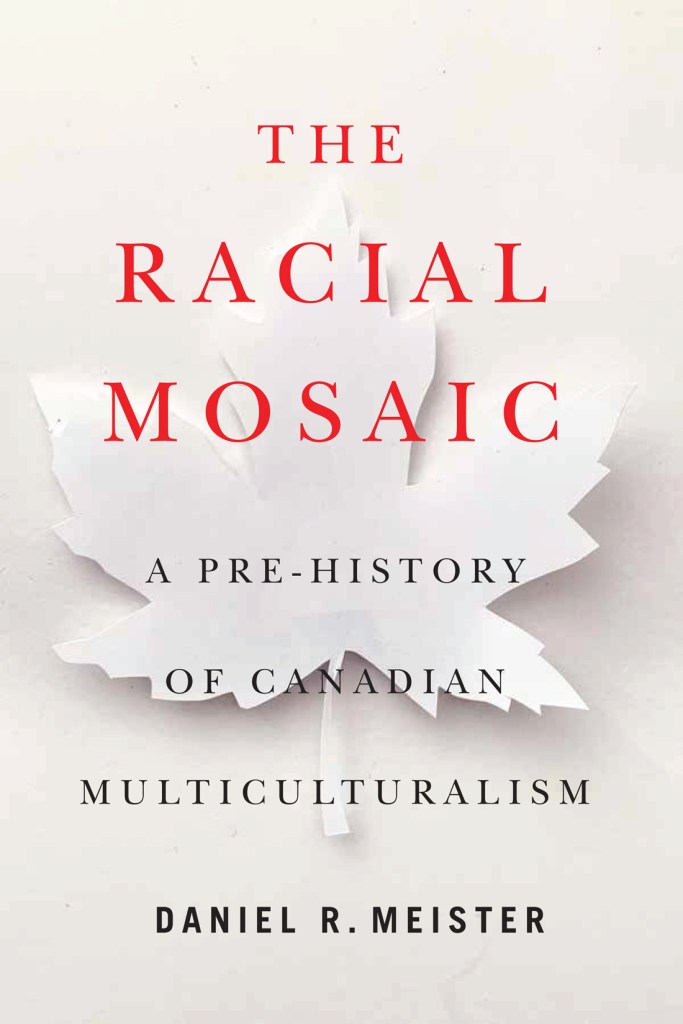
The Racial Mosaic: A Pre-History of Canadian Multiculturalism.
Rethinking Canada in the World series, no. 10. Montreal and Kingston: McGill-Queen’s University Press, December 2021.
Finalist, 2022 John W. Dafoe Book Prize, J.W. Dafoe Foundation
Finalist, 2022 Wilson Book Prize, L.R. Wilson Institute for Canadian History
One of Quill and Quire’s 2022 “Books of the Year”
***
Canada is often considered a multicultural mosaic, welcoming to immigrants and encouraging of cultural diversity. Yet this reputation masks a more complex history. In this groundbreaking study of the pre-history of Canadian multiculturalism, Daniel Meister shows how the philosophy of cultural pluralism normalized racism and the entrenchment of whiteness.
The Racial Mosaic demonstrates how early ideas about cultural diversity in Canada were founded upon, and coexisted with, settler colonialism and racism, despite the apparent tolerance of a variety of immigrant peoples and their cultures. To trace the development of these ideas, Meister takes a biographical approach, examining the lives and work of three influential public intellectuals whose thoughts on cultural pluralism circulated widely beginning in the 1920s: Watson Kirkconnell, a university professor and translator; Robert England, an immigration expert with Canadian National Railways; and John Murray Gibbon, a publicist for the Canadian Pacific Railway. While they all proposed variants of the idea that immigrants to Canada should be allowed to retain certain aspects of their cultures, their tolerance had very real limits. In their personal, corporate, and government-sponsored works, only the cultures of “white” European immigrants were considered worthy of inclusion.
On the fiftieth anniversary of Canada’s official policy of multiculturalism, The Racial Mosaic represents the first serious and sustained attempt to detail the policy’s historical antecedents, compelling readers to consider how racism has structured Canada’s settler-colonial society.
Edited Collection
(with David Veltman)
Biography Across the Digitized Globe: Essays in Honour of Hans Renders. Biography Studies series, no. 4. Leiden and Boston: Brill, 2025.
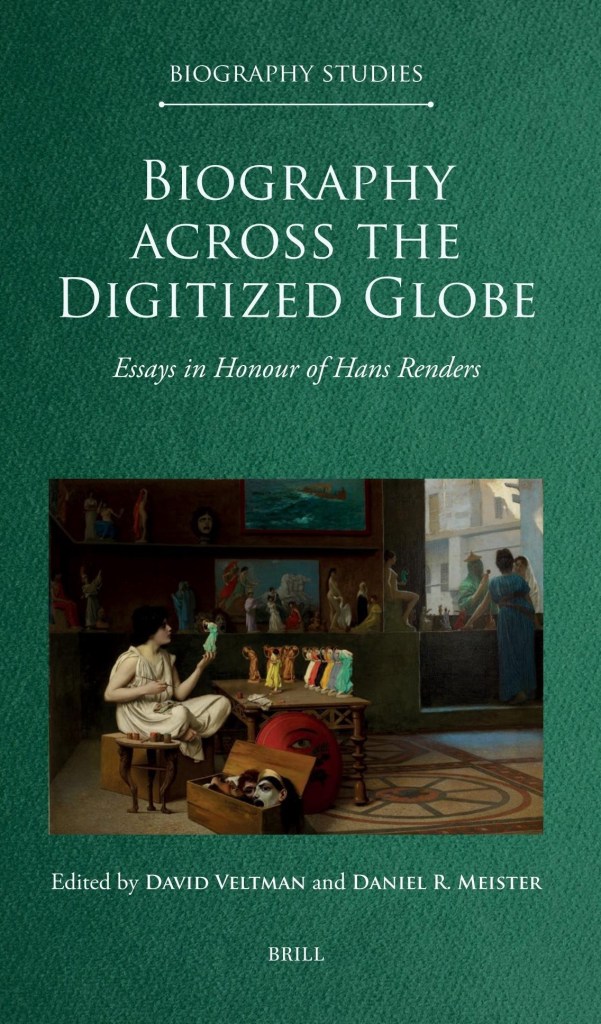
This volume is dedicated to Professor Hans Renders, founder of the Biography Institute of the University of Groningen, the Netherlands. Throughout his academic career, Renders witnessed a reflexive turn in historical research: biographers became more open about the limitations of their sources, and the subjective nature of their selection. Over this same period, however, the availability of digital sources has increased exponentially, which has profound implications for biographical research and the transnational framework used to approach the genre. Through its thirteen thought-provoking essays, this work intervenes in Biography Studies by bringing the well-developed reflexive tradition to bear on the pressing challenge of proliferating digitized sources.
Peer-Reviewed Articles
“Through the Eyes of a Guard: Watson Kirkconnell and Great War Internment in Canada.” Canadian Military History 34, no. 1 (2025): 1-41.
Histories of internment in Canada have paid much attention to internees’ experiences but far less to those of the guards. Correcting this trend, this article offers a detailed case study of one soldier, Watson Kirkconnell, who worked at the Fort Henry and Kapuskasing internment camps. Drawing on his valuable but heretofore unutilised archive of material, this article provides a vivid social history of the camps through Kirkconnell’s eyes. Nuancing the historiography of wartime internment, this article demonstrates how commandants determined the experiences of both internees and guards alike and, at the same time, that staff could sometimes mitigate their superior’s cruelty.
“‘One of the Cultural Minorities’? Indigenous Peoples and the Creation of Official Multiculturalism.” Canadian Historical Review
106, no. 1 (March 2025): 57–82.
Through an examination of the broader push for multiculturalism in the late 1960s and early 1970s, this article challenges the idea that Indigenous peoples were not part of the discussions that led to the policy of multiculturalism. It demonstrates that Indigenous peoples’ activism directly led to some inclusion in the early years of the Royal Commission on Bilingualism and Biculturalism, and that ethnic minorities took some tentative steps towards building political alliances with Indigenous peoples. However, the possibility of a less colonial, more inclusive “syncretic multiculturalism” was dashed by two factors: the White Paper’s assault Indigenous identities, which diverted Indigenous leaders’ engagement with multicultural activists, and the passive revolutionary outcome of a policy of “multiculturalism within a bilingual framework,” which originally excluded but then was quickly extended to include Indigenous peoples.
“Whiteness in Canada: History, Archives, Historiography.”
Canadian Historical Review 105, no. 1 (March 2024): 74–95.
This article opens with autobiographical reflections outlining how the author came to study the histories of race, racism, and whiteness in Canada; namely, through a biographical examination of Canadian academic and public intellectual Watson Kirkconnell. The article then discusses the author’s engagement with the scant Canadian literature on race science/scientific racism. After defining whiteness and discussing its relationships with gender and class, the article provides suggestions for future research on race and whiteness in Canada; in particular, the need for definitional, temporal, and geographical specificity; the need for original archival research and collaboration with archivists; and the importance of biographical research. Drawing connections between the past and present, the article concludes by stressing the importance of this research.
“Ethnicity to Equity? Official Multiculturalism and Racial Discrimination in Canada, 1971-79.” In “Review, Assessment, and Perspective on Fifty Years of Canadian Multiculturalism (1971-2021),” ed. Françoise Le Jeune and Laurence Cros. Special issue, Études canadiennes/Canadian Studies 95 (December 2023): 43–72.
Analyses of multiculturalism’s evolution in Canada suggest that in the 1970s the policy was narrowly focused on cultural festivities and that a turn to anti-racism did not occur until the 1980s. This article reexamines this period and draws two main conclusions. First, although the policy was aimed at Euro-
Canadians, the door was open for the participation of people groups racialized as non-white (though structural barriers limited their access); and second, that anti-discrimination had long been a goal within the bureaucracy but attempts to implement concrete measures were stymied by a lack of
support, and sometimes outright opposition, from various stakeholders.
“‘Anglo-Canadian Futurities’: Watson Kirkconnell,
Scientific Racism, and Cultural Pluralism in Interwar Canada.”
Settler Colonial Studies 10, no. 2 (2020): 234–56.
This article contributes to the understudied histories of scientific racism and cultural pluralism in Canada by exploring the early life and thought of Watson Kirkconnell. Kirkconnell, a university professor, administrator, and public intellectual, is perhaps best known for his promotion of tolerance through the translation and promotion of European and so-called new Canadian poetry. However, a closer examination of his early writings reveals an adoption and adaption of Anglo-American race science to justify the discrimination of peoples racialized as non-Anglo-Saxon. Though he later assumed a more tolerant stance towards Europeans, it relied on a different interpretation of the same race science and as such continued to exclude those racialized as non-white.
“The Biographical Turn and the Case for Historical Biography.”
History Compass 16, no. 1 (January 2018).
Biography has long been ostracized from the academy while remaining a popular genre among the general public. Recent heightened interest in biography among academics has some speaking of a biographical turn, but in Canada historical biography continues to be undervalued. Having not found a home in any one discipline, Biography Studies is emerging as an independent discipline, especially in the Netherlands. This Dutch School of biography is moving biography studies away from the less scholarly life writing tradition and towards history by encouraging its practitioners to utilize an approach adapted from microhistory. In response to these developments, this article contends that the discipline of history should take concrete steps to strengthen the subfield of Historical Biography. It further argues that works written in this tradition ought to chart a middle path between those studies that place undue focus on either the individual life or on broader historical questions. By employing a critical narrative approach, works of Historical Biography will prove valuable to both academic and non‐academic readers alike.
Peer-Reviewed Book Chapters
“Biography Across Borders: Broadening Biography Studies.” In Biography Across the Digitized Globe: Essays in Honour of Hans Renders, edited by David Veltman and idem, 242–63. Leiden and Boston: Brill, 2025.
This chapter provides some suggestions for future research directions for scholars of biography studies. First, that they make a serious and sustained attempt to distinguish between theory and methods. Second, that they also abandon the notion of the biographer as theory-averse and abandon the quest for an underlying theory for the discipline, and instead seek to engage with whatever theory is most relevant to the life of the individual under study, with this theory shaping the text to varying degrees depending on the intended audience. Third, that they work to resolve the tension between the foundational claim that biography provides empirical truth about an individual and the admission that biography is inherently revisionist. Fourth, that they build bridges with other related fields and subfields, especially oral history and narrative studies. Finally, that they abandon their antipathy towards Life Writing and acknowledge the importance and difficulty of writing the lives of the marginalized.
“Historical Biography in Canada: Historians, Publishers, and the Public.” In Different Lives: Global Perspectives on Biography in Public Cultures and Societies, edited by Hans Renders and David Veltman, 21–40.
Leiden and Boston: Brill, 2020.
Seeking to examine the state of the art of biography in Canada, this chapter turn to some pragmatic yet unanswered questions: How do academic publishers view biographies? How well do scholarly biographies sell? What is the primary market for serious biographies, and is it more expansive than those of other genres published by academic presses and trade publishers? Finally, how are historians approaching the art of biography?
Entries in Reference Works
“Kate Adele Foster (Pattullo).” Dictionary of Canadian Biography (forthcoming).
“The Barr Colonists.” The Canadian Encyclopedia (September 2023).
“IODE (Imperial Order Daughters of the Empire).” The Canadian Encyclopedia (January 2023).
“John Murray Gibbon.” The Canadian Encyclopedia (October 2022).
“Robert England.” The Canadian Encyclopedia (October 2022).
“Thomas Watson Kirkconnell.” The Canadian Encyclopedia (October 2022).
Other Articles
“Soundbite Histories.” Active History (3 December 2024).
“The Spokesman: Gender and the Liberal Party in 1960s New Brunswick.” Active History (1 November 2024).
“A Plea for Depth Over Dismissal.” Active History (4 June 2024).
(With Daniel Panneton.) “How Three Big Conspiracy Theories Took Root in Canada.” The Walrus (21 May 2024).
“Who Killed the History of Canadian Multiculturalism?” Active History (12 March 2024).
“‘Know thy enemy and know yourself’: ChatGPT and the Historian.” Intersections 6, no. 2 (December 2023): 19.
“‘Rather Absurd’: Christian Nationalism and the Dominion of Canada.” Active History (7 September 2023). Republished by the NB Media Co-op (14 September 2023).
“In Praise of ‘the Multiculturalism Clause.’” Winnipeg Free Press (18 April 2022).
“The Barr/Britannia Colony.” Canadian Museum of Immigration at Pier 21 (January 2022).
“Historicizing Multiculturalism.” In “Multiculturalism @ 50 and the Promise of a Just Society,” edited by Will Kymlicka. Special issue, Canadian Issues/Thèmes canadiens (Fall/Winter 2021): 10–14.
“The Canadian Mosaic, Archival Silences, and an Indigenous Presence in Banff.” The Cairn (18 July 2020). Revised version published in Active History (18 August 2020).
Book Reviews
Decolonize Multiculturalism by Anthony C. Alessandrini. Journal of Critical Race, Indigeneity, and Decolonization 2, no. 2 (December 2025).
On the Other Hand: Canadian Multiculturalism and its Progressive Critics, by Phil Ryan. Canadian Journal of Political Science 58, no. 4 (Dec. 2025): 982–3.
Biography: An Historiography, by Melanie Nolan. Australian Journal of Biography and History 8 (2024): 227–31.
Canadian Multiculturalism and the Far Right: Walter J. Bossy and the Origins of the ‘Third Force,’ 1930s–1970s, by Bàrbara Molas. Canadian Historical Review 104, no. 3 (September 2023): 451–52.
In the Public Good: Eugenics and Law in Ontario, by C. Elizabeth Koester. University of Toronto Quarterly 92, no. 3 (August 2023): 348–49.
People, Politics, and Purpose: Biography and Canadian Political History, edited by Greg Donaghy and P. Whitney Lackenbauer. American Review of Canadian Studies 53, no. 2 (2023): 286–88.
Identity and Industry: Making Media Multicultural in Canada, by Mark Hayward. Canadian Historical Review 102, no. 4 (December 2021): 669–71.
Sam Steele: A Biography, by Rod MacLeod. Canadian Historical Review 101, no. 20 (June 2020): 307–09.
Citizenship in Transnational Perspective: Australia, Canada, and New Zealand, edited by Jatinder Mann. Canadian Historical Review 99, no. 2 (June 2018): 325–27.
 Daniel R. Meister